Views: 0 Author: Site Editor Publish Time: 2026-09-30 Origin: Site
Ice hockey demands split-second processing. You are grinding out a heavy shift. Your heart pounds. You track a puck moving at blistering speeds through a maze of skates and composite sticks. In this high-velocity environment, visual clarity is your primary defense mechanism.
Unfortunately, equipment failures compromise both performance and physical well-being. Lenses fog during intense mid-shift exertion. Stray sticks cause micro-abrasions. Cheap plastics pose severe shatter risks upon impact. Upgrading your Hockey Eyewear is an absolute necessity for competitive play. This technical guide breaks down the exact polymer materials, structural geometries, and chemical coatings you need to evaluate. We will help you make a safety-first, data-driven purchasing decision.
Polycarbonate Substrates: High-impact polycarbonate remains the only scientifically validated lens material trusted for kinetic energy dispersion on the ice.
Dual-Coating Engineering: Premium shields require independent chemical treatments. This includes an inner hydrophilic coating for moisture management and an outer hard coating to resist abrasions.
Geometric Optics: The structural choice between flat, aviator, and bubble profiles directly dictates peripheral field of view and baseline light refraction.
Laboratory Certifications: Always verify that your chosen shield meets rigorous HECC, CSA, or CE safety standards before stepping onto the rink.
When evaluating facial protection, the base substrate dictates its failure threshold. Lower-end visors occasionally use acrylic or standard composite plastics to cut production costs. They look clear initially. However, they are inherently brittle. Under freezing ambient rink temperatures, acrylic loses elasticity. A high-speed puck strike can fracture these materials into dangerous shards. Furthermore, inferior plastics suffer from poor light transmission, causing subtle visual distortion that disorients players during rapid transitions.
High-impact polycarbonate is the undisputed industry standard. As a tough, dimensionally stable thermoplastic polymer, its impact resistance dwarfs standard acrylic. Polycarbonate flexes upon impact. It absorbs and disperses kinetic energy rather than snapping. This molecular integrity ensures maximum Hockey Safety. Additionally, polycarbonate is significantly lighter than alternative plastics and naturally blocks harmful UV radiation. It is the perfect foundational material for professional-grade gear.
Loss of visibility from condensation ruins shifts. To stop it, we must analyze rink thermodynamics. A player generates massive body heat and heavy perspiration. Warm, moisture-rich air radiates upward into the helmet. Meanwhile, the ambient ice temperature hovers near freezing. When hot breath hits the freezing inner shield, moisture cools below its dew point. It condenses into microscopic droplets that scatter incoming light.
Premium Fog-resistant Eyewear relies on advanced chemical engineering. The most effective solution is a factory-applied hydrophilic coating on the interior. Rather than forcing water to bead up, this layer absorbs moisture. It forces the water to spread evenly as a continuous, transparent micro-film. Light passes through without distortion.
Recent market evaluations of sports optics reveal a definitive shift toward permanent, UV-cured nano-coatings. Players now demand zero-maintenance gear. Consequently, leading manufacturers are abandoning temporary hydrophobic sprays. These aftermarket sprays wash off easily with sweat. Instead, the industry has moved to baked-in hydrophilic treatments that molecularly bond to the polycarbonate substrate, offering reliable, season-long performance.
Visors exist in a highly abrasive environment. Surprisingly, the worst damage rarely happens during actual gameplay. Think about tossing your helmet into a gear bag after a late-night game. The lens rubs against exposed skate blades and metal hardware. On the ice, abrasive shavings and rough gloves contribute to surface wear. Players often ruin their gear by wiping away sweat with a dirty jersey.
To extend lifespan, a high-quality Anti-scratch Visor utilizes a specialized outer hard coat. During manufacturing, the exterior polycarbonate is treated with a siloxane-based or polyurethane resin. This is thermally baked or UV-cured to create a hardened shell. While no transparent polymer is entirely immune to deep gouges from sharp metal, factory-grade hard coatings drastically increase surface hardness. They effortlessly deflect standard micro-abrasions that would otherwise ruin optical clarity within weeks.
Physical geometry dictates breathability, coverage, and visual accuracy. Different positions and personal preferences determine the optimal shape for your specific game.
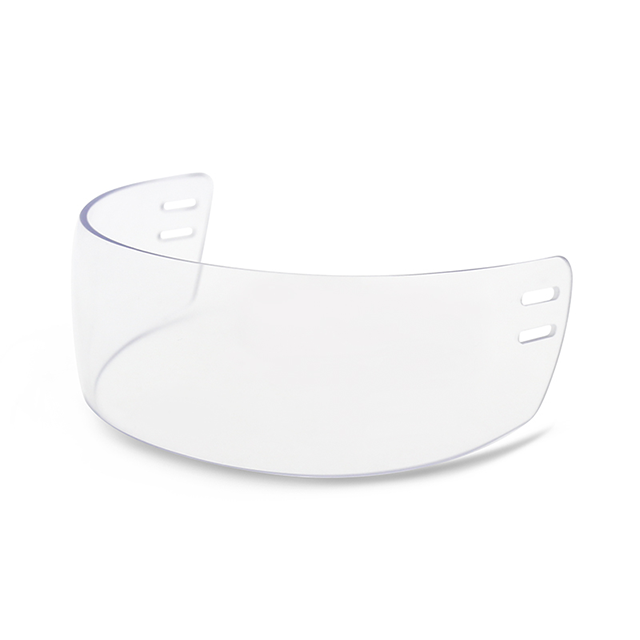
The straight cut remains the traditional choice for professional forwards. The vertical axis is relatively flat, introducing minimal optical distortion. It sits further from the face, providing excellent airflow to naturally aid fog reduction. Conversely, aviator and bubble designs feature contoured bottom edges dipping lower over the cheekbones. Bubble visors utilize an outward convex curve. They maximize coverage and peripheral vision. However, multi-axis curvature alters light refraction. Cheap manufacturing creates a prism effect, ruining depth perception.
To counteract this prismatic error, a premium Optical Visor uses optical decentering. Through advanced injection molding, the lens is crafted marginally thicker at the optical center and tapers at the peripheral edges. This precise tapering corrects light refraction, ensuring true and accurate vision.
Lens Profile | Optical Clarity | Airflow & Breathability | Best Suited For |
|---|---|---|---|
Straight Cut | Exceptional. Minimal multi-axis distortion. | High. Sits further from the face. | Forwards prioritizing maximum vision and cooling. |
Aviator | Excellent, provided optical decentering is used. | Moderate. Closer fit to the cheekbones. | Defensemen needing lower facial coverage. |
Bubble | Requires high-end manufacturing to prevent prism effects. | Lower. Traps more heat due to convex shape. | Players requiring maximum peripheral protection. |
Objective safety standards ensure equipment performs under catastrophic impact. Always look for HECC, CSA, or CE certification stickers. These shields must successfully withstand direct impacts from frozen pucks fired exceeding 90 mph. Purchasing uncertified facial protection is a dangerous gamble.
Maintenance dictates longevity. Even advanced dual-coated lenses fail rapidly if subjected to improper care. Walk into any locker room, and you will see players scrubbing their gear with sweaty towels. This destroys chemical coatings.
Always flush the lens with lukewarm water first to remove abrasive salt crystals. Apply a single drop of pH-neutral soap. Gently rub with clean fingers. Pat dry using a premium optical microfiber cloth. Never use household glass cleaners containing ammonia. They chemically degrade polycarbonate and strip hydrophilic layers. Avoid paper towels; their coarse wood fibers act like sandpaper.
Sourcing equipment from specialized optical engineering manufacturers is critical for long-term performance. Depending on your rink conditions, you might prioritize heavy-duty hydrophilic coatings for humid environments or maximum scratch resistance for aggressive play.
For players seeking professional-grade performance, GY Optical engineers visors with advanced dual-coating technology. Utilizing premium high-impact polycarbonate, their products ensure maximum kinetic energy absorption. The independent application of an internal hydrophilic layer and an external hard-coat resin delivers uncompromised fog resistance and durability. Furthermore, their injection-molded optical decentering guarantees zero visual distortion.
Evaluate your current setup. If your vision is compromised by scratches or constant fogging, it is time to upgrade. Explore the precise optical solutions at GY Optical to find the exact shield or cage that fits your helmet and playing style.
With proper care and adherence to strict maintenance protocols, a factory-applied hydrophilic coating lasts between one to two full playing seasons. However, the lifespan is heavily dependent on usage frequency and cleaning habits. Exposing the lens to harsh chemicals, ammonia, or abrasive wiping degrades the coating prematurely.
No. Attempting to buff out or polish a scratch on a polycarbonate lens is highly discouraged. Abrasive polishing compounds permanently strip the protective anti-scratch and anti-fog coatings from the surrounding area. Buffing alters the physical thickness of the plastic, creating severe optical distortion. It is always recommended to replace a heavily scratched shield.
Legality depends entirely on your specific league rulebook. Most youth, high school, and amateur leagues strictly require completely clear visors. This ensures medical staff and referees can see a player's eyes to assess for concussions. Tinted visors are generally reserved for specific professional leagues or players with documented medical exemptions.
Yes. From an engineering standpoint, high-impact polycarbonate is the only transparent polymer possessing the necessary tensile strength to reliably pass HECC and CSA certification tests. Alternative materials like acrylic are highly prone to shattering upon impact, posing a severe danger to the face.
Applying aftermarket hydrophobic sprays on a factory-coated hydrophilic lens is a mistake. The chemical structures conflict. The spray sits on top of the factory coating, creating a smeared, blurry film. If your factory coating has completely worn off, sprays offer a temporary fix, but they wash away quickly with sweat.
Professional players often prioritize maximum optical clarity and breathability over extended facial coverage. A flat shield introduces the least amount of multi-axis curvature, virtually eliminating peripheral distortion. Additionally, the straight cut sits slightly further from the face, allowing superior airflow to naturally dissipate body heat.