Views: 0 Author: Site Editor Publish Time: 2026-09-17 Origin: Site
A split-second reaction defines a hockey game. When players step onto the ice, they rely on instinct, skill, and crystal-clear vision. Because high-speed impacts are inevitable, highly reliable Hockey Eyewear is an absolute necessity rather than a luxury.
For B2B buyers, equipment managers, and sports retailers, purchasing protective gear in bulk lots makes economic sense. Mass production, however, often hides dangerous manufacturing defects. A single golden prototype might look flawless in a boardroom. Yet, bulk lots can harbor inconsistencies that compromise durability and player protection. Understanding these common manufacturing flaws is crucial for buyers. We are talking about severe issues ranging from chemical coating delamination to optical distortion. This engineering guide breaks down exactly what defects to look out for and how to spot them early.
Coating Failures are Common: Delamination, bubbling, or uneven application of the exterior layer represent the most frequent defects found in bulk shipments.
Optical Clarity is Non-Negotiable: Even minor warping in the polycarbonate material turns a protective shield into a serious hazard by distorting a player's field of vision.
Mounting Points are Vulnerable: Micro-cracks around the drill holes frequently occur during mass production. These severely compromise impact resistance and structural integrity.
Quality Control Saves Money: Auditing a random sample from a lot ensures strict compliance with mandatory safety certifications like HECC, CSA, and CE standards.
Understanding the manufacturing cycle of polycarbonate shields is essential for evaluating product quality. The production process involves high-temperature injection molding, followed by chemical coating applications, and finally a controlled UV or thermal curing phase. Raw polycarbonate is highly sensitive to temperature fluctuations and environmental contaminants. Even slight deviations on the factory floor can compromise an entire production run.
Recent industry analysis indicates a massive shift in the sports equipment market. Players increasingly demand higher performance in fluctuating arena temperatures. This demand has surged the market for complex, dual-coated shields featuring both hydrophilic and hydrophobic layers. Consequently, this manufacturing complexity has led to a noticeable spike in batch-level defect reports. To combat this, leading facilities are now integrating advanced automated optical inspection systems. Regulatory bodies are pushing for stricter baseline testing. Buyers can no longer rely on superficial visual checks.
Assuming every unit in a massive lot is identical presents a significant operational risk. Standard acceptable quality limits dictate that a small percentage of defects is statistically probable. If a factory experiences a systemic failure, such as a malfunctioning curing oven or a contaminated cleanroom, an entire batch is ruined. Failing to inspect these lots upon arrival leads to severe consequences. Defective protective gear directly compromises player safety and exposes retailers to massive liability claims.
One of the most prevalent flaws in mass-produced shipments is the failure of the protective exterior layer. A premium Anti-scratch Visor relies on a specialized hard coating. This is typically a polysiloxane-based chemical designed to resist abrasions from sticks and pucks. When this coating is not bonded correctly to the polycarbonate substrate, it begins to peel, flake, or delaminate prematurely.
Coating failures in bulk lots generally stem from environmental or mechanical errors during the complex curing process. The primary causes include improper temperature control and surface contamination. The chemical dipping process requires exact temperature and humidity parameters. If the curing ovens run too cool, the cross-linking of the chemical polymers remains incomplete. This leads to weak adhesion. Furthermore, cleanrooms must maintain strict particle counts. Microscopic dust or machine oil settling on the raw plastic creates invisible barriers that prevent proper bonding.
Identifying delamination early prevents defective units from reaching the ice. Inspectors should hold the shield under harsh fluorescent lighting. Look for cloudy patches or a subtle rainbow effect indicating uneven coating thickness. A practical tactile test involves running a fingernail gently along the rim to reveal any brittle textures. A properly cured coating feels completely seamless.
A top-tier Optical Visor must offer zero visual distortion. The natural curvature of the shield refracts light. Precision injection molds are engineered to compensate for this geometry to ensure a true line of sight. Flawed manufacturing lots often contain units with localized wavy spots or refractive errors.
Optical distortion is a critical safety hazard. Imagine a high-speed breakaway where a winger misjudges a pass because of a slight wave in their peripheral curve. Visual displacement causes misjudgment of puck speed and opposing player positioning. Prolonged use forces the eyes to constantly adjust. This leads to acute eye strain, dizziness, and delayed reaction times.
To verify optical integrity, buyers must implement standardized testing protocols. The most reliable method is the grid test. Hold the shield at a fixed distance of roughly 18 inches and look through it at a perfectly straight grid pattern on a wall. As you pan the plastic side to side, the lines must remain perfectly straight. If the lines bend or blur, the unit suffers from optical distortion. This flaw is almost always caused by uneven thickness resulting from inconsistent cooling rates during the injection process.
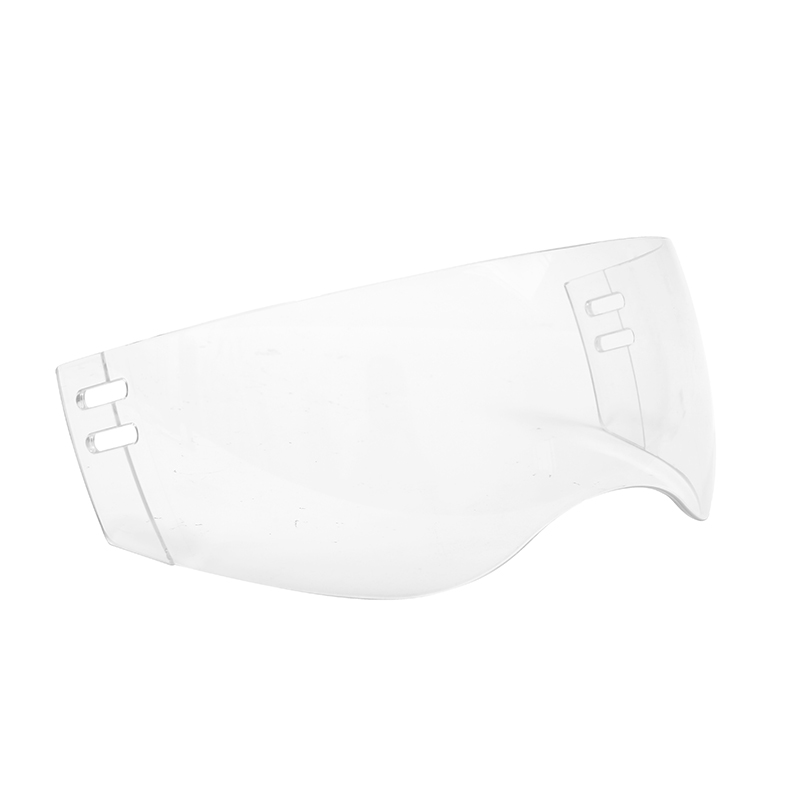
The fundamental purpose of a Hockey Visor is facial and ocular protection. Any flaw compromising the structural integrity of the high-impact polycarbonate completely defeats this purpose. Large visible cracks are easily discarded. Micro-cracks, however, are insidious defects. They frequently occur during mass production and turn a protective barrier into a dangerous fragmentation hazard.
The mounting points endure the highest stress levels. During production, these holes are either molded directly or drilled post-injection. If the factory uses dull drill bits, the resulting friction and heat create microscopic spider-web cracks. Improper annealing, the process of slowly cooling the plastic to relieve internal stress, leaves these mounting points highly brittle. Kinetic energy from a high-velocity puck travels directly to these micro-cracks. The plastic shatters catastrophically rather than absorbing the blow.
Structural flaws are not always visible to the naked eye. Relying on certified testing is mandatory. Flawed lots with micro-fissures consistently fail standardized drop-ball tests. Buyers must ensure the specific lot meets rigorous HECC and CE safety requirements.
Modern players demand clear vision in rapidly fluctuating temperatures. This drives the popularity of dual-coated equipment. Premium models feature an exterior hard coating to resist physical damage alongside an interior hydrophilic layer to manage moisture. Applying two distinct chemical layers to a single piece of polycarbonate is a highly complex process prone to batch errors.
A common defect occurs when there is inadequate separation between the two chemical applications. If the hydrophobic and hydrophilic chemicals mix along the edges, they trigger a chemical reaction. This results in a permanent milky haze on the surface. In contrast, if the interior layer is baked at the wrong temperature, it completely loses its moisture-absorbing properties.
Buyers can simulate on-ice conditions by exposing samples to rapid temperature changes. Moving a test unit from a commercial freezer directly into a warm, highly humid room immediately reveals if the moisture integration functions uniformly.
Precision dimensions are critical for protective sports equipment. Polycarbonate is a thermoplastic injected into molds as a molten liquid. It must cool into a rigid state. If a factory prioritizes speed over quality and ejects the units from their molds too early, the plastic inevitably warps in the ambient air.
Imagine unpacking a shipment of a thousand units only to find the mounting slots fail to align with standard professional helmet brackets. A warped shield presents immediate compatibility problems. Forcing a warped piece of gear creates immense internal tension within the polycarbonate. This drastically reduces impact resistance and makes it highly susceptible to cracking upon the first physical impact.
To streamline the inspection process, B2B buyers should benchmark shipments against strict engineering tolerances. Below is a core comparison table highlighting the differences between a high-quality batch and a defective lot.
Inspection Parameter | High-Quality Production Lot | Defective / Flawed Lot |
|---|---|---|
Material Specification | Optical Class 1 High-impact Polycarbonate | Recycled or low-grade PC mixed with impurities |
Coating Adhesion | Passes standardized steel wool abrasion testing | Flaking, bubbling, or rainbow effect under fluorescent light |
Optical Clarity | Zero distortion during the 18-inch grid test | Wavy sections causing visual displacement and eye strain |
Mounting Integrity | Smooth, stress-relieved drill holes | Micro-cracks radiating from mounting slots |
Certifications | Batch-specific CE, CSA, and HECC compliance reports | Outdated or generic factory ISO certificates only |
Procuring protective equipment requires a rigorous approach to quality assurance. Establishing a standardized inspection routine identifies manufacturing inconsistencies before the equipment reaches the arena. This ensures robust Hockey Safety for the end-user.
The foundational step is verifying documentation and inspecting representative samples. Buyers must explicitly request a random sampling pulled directly from the actual production run. Relying solely on a meticulously crafted prototype is a common pitfall. Reputable manufacturers provide up-to-date ISO 9001 certifications and third-party laboratory testing reports specific to the purchased batch.
Conducting independent in-house durability tests adds an essential layer of verification. A standard scratch test involves using specific grades of steel wool applied with consistent pressure. The coating should show no signs of deep penetration. Bending the plastic slightly beyond its standard curvature reveals hidden flaws. Auditors should listen closely for micro-cracking sounds during this flexibility test.
An impact-resistant shield offers vital protection and clarity for athletes operating in a high-speed environment. Purchasing in bulk lots can obscure dangerous manufacturing flaws. From coating delamination and visual warping to microscopic stress fractures, these defects compromise both the lifespan of the product and the safety of the player.
Prioritizing player protection means never cutting corners on quality control. Always audit random samples before finalizing bulk purchases. Demand clear batch-specific testing certificates from your suppliers. By rigorously vetting your manufacturing partners and implementing strict in-house testing, you ensure the gear keeps players safe and focused. For B2B buyers seeking reliable, certified, and optically perfect protective equipment, exploring established manufacturers like GY Optical ensures your bulk investments meet the highest professional standards.
Under normal playing conditions and with appropriate maintenance, a high-quality exterior coating maintains its integrity for one to two full competitive seasons. If a manufacturing flaw is present, such as improper thermal curing at the factory, the protective layer may begin peeling or bubbling within the first few weeks of use.
No, it is not possible to safely repair the plastic once the protective layer has failed. Attempting to buff out a scratch with abrasive compounds mechanically removes material from the surface. This alters the uniform thickness of the polycarbonate and creates localized visual distortion. A compromised unit must be entirely replaced.
Not necessarily. The term optical primarily refers to the visual clarity and lack of distortion inherent in the base polycarbonate material. While most modern gear includes some baseline level of scratch resistance, a true hard-coated surface is a secondary manufacturing process. Always verify product specifications to ensure an industry-standard hard coating has been applied.
Inconsistencies within a single manufacturing lot are typically the result of minor fluctuations during the injection molding or curing processes. If the cooling rate is not perfectly uniform across the entire mold, the material warps on a microscopic level. Even a deviation in thickness of a fraction of a millimeter alters how light refracts.
Verifying safety ratings requires checking both the physical product and the manufacturer's documentation. Inspect the units for permanent stamps indicating certification from recognized bodies like HECC, CSA, or CE. More importantly, request specific batch testing reports to ensure the lot passed strict high-velocity impact standards.
Polycarbonate is highly sensitive to extreme thermal shifts. Moving rapidly from a freezing ice rink to a heated locker room causes the material to expand and contract. In poorly manufactured lots, this thermal shock exacerbates hidden micro-cracks around the mounting holes and degrades the adhesion of the chemical coatings.
In industrial manufacturing, the Acceptable Quality Limit defines the maximum number of defective units allowed in a batch before the entire lot is rejected. For critical safety gear like eye protection, reputable factories operate on an extremely strict AQL, often rejecting a batch if even 1 to 2 percent of the sampled units show structural or optical flaws.